If you’re seeking a facelift, you’ve probably heard the terms “deep plane facelift” and “SMAS facelift.” But what’s the difference? Which one creates better results, and which is right for your level of skin laxity and facial aging?
In this article, I’ll explain:
- How each facelift technique works,
- What makes them different, and
- How I determine which option is best for my patients.
We’ll talk about incision placement, degree of correction, recovery time, and how to achieve natural, long-lasting results.
At Elite Facial Plastic Surgery, we specialize in facial rejuvenation procedures, using advanced facelift techniques to rejuvenate without looking “pulled.” I’m Dr. Dominic Castellano, a double board-certified facial plastic surgeon, and I’ve helped countless patients like you achieve beautiful, natural-looking results with deep plane and SMAS facelifts.
Want to restore youthful contours and confidence? Schedule your facelift consultation today to find out which technique can give you the most natural-looking results.
How Are Deep Plane and SMAS Facelifts Similar?
Both are types of facelift procedures that correct facial sagging and restore a youthful appearance. Both will provide improvements, but depending on your degree of correction, age, and the amount of facial laxity, one may be a better fit for you.
Incision Placement
The one thing both procedures have in common is the incision.
For most facelifts, the incision begins in front of the ear, follows the contour of the ear, curves behind the ear, and extends into the hairline.
The only difference lies in incision placement for males vs. females, as men often have facial hair and different skin tension patterns. But overall, the incision pattern is similar for both procedures.
Once the incision is made, the skin and subcutaneous tissues are elevated off the SMAS layer, and this is where the two techniques start to differ.
Key Differences Between SMAS and Deep Plane Facelifts
The SMAS Technique
SMAS stands for the superficial musculoaponeurotic system, which is basically a fine muscle layer that communicates with the lower neck muscles, including the platysma.
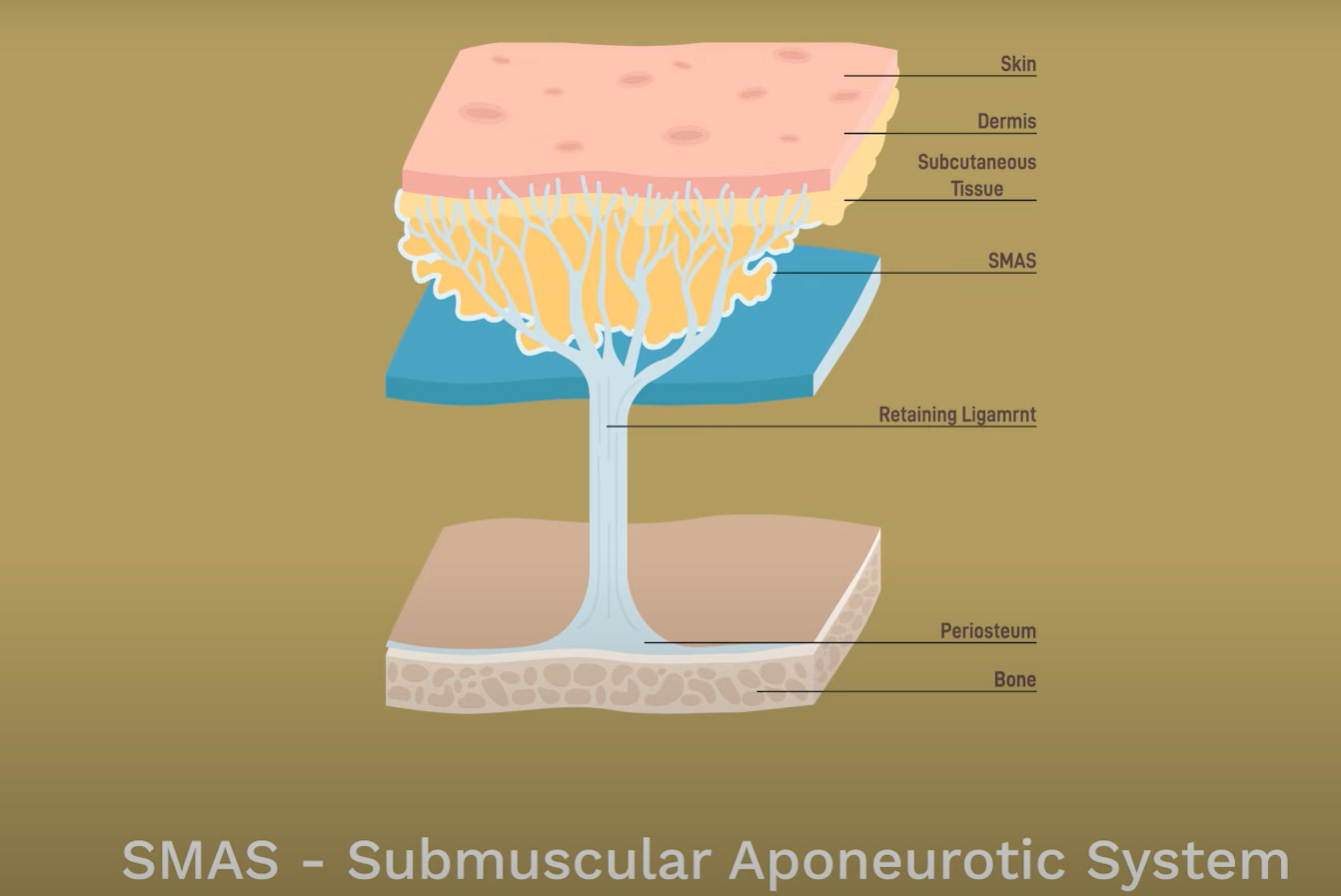
When doing a SMAS lift, there are a couple of different techniques you can use:
- Plication: The SMAS layer is folded over itself and tightened with sutures to create lift.
- Imbrication: A strip of the SMAS is removed, and the two edges are sutured together, closing the gap and tightening the tissue.
The Deep Plane Technique
With a deep plane facelift, I still incise the SMAS layer, but instead of just suturing it together, I elevate the tissue below the SMAS and extend the dissection beneath the jaw and under the platysma muscle.
With this technique, I dissect more forward, which allows me to free up various ligaments in the face between the cheek and the skin. By freeing those up, it allows me to release the tissues more and achieve a more robust pull.
The deep plane lift obviously involves more dissection, and it takes more time, so you’re going to get a stronger pull.
Who Should Get A Deep Plane Facelift?
I typically recommend a deep plane facelift for individuals who have significant laxity, or for patients who are older and want more dramatic correction.
Not everyone needs a deep plane lift; it depends on how much correction you want.
Compared to a SMAS lift, a deep plane lift can provide better correction in the jowling as well as the upper face. Both procedures provide correction along the neckline, because when you tighten the SMAS up in the face, you’re also tightening the platysma muscle below that communicates with it.
This helps restore and correct along the jawline, in addition to some lift in the upper face. But by far, the deep plane lift provides more correction.
Cost Differences
The cost of a SMAS lift is far less than a deep plane lift, as the procedure length is normally about 3 hours, whereas a deep plane lift takes about 4.5–5 hours.
The longer operative time and advanced technique make a deep plane facelift more expensive.
Downtime and Longevity
From a downtime standpoint, the two procedures are very similar. There shouldn’t be much more downtime with the deep plane lift compared to the SMAS lift.
From a longevity standpoint, you’ll get a bit more longevity with a deep plane lift compared to the SMAS. This technique involves a bit more dissection, and you’re definitely getting a stronger pull.
Natural-Looking Results
So, in regard to whether one procedure looks more natural than the other, they both should give you a natural look.
I can tell you personally, with my technique, I want all my patients to have a natural, non–“pulled” look. It’s really about determining how much correction you want, and ultimately, if you’re a candidate for one, or both, for that matter.
This is something you’ll discuss with your surgeon.
How to Choose the Right Facelift
So, how do you choose the right facelift for your aesthetic goals?
It really depends on what you’re looking to achieve and what shows on your exam findings.
Here’s a general guide I share with patients:
- Mid to late 40s or early 50s: Mild to moderate laxity in the jawline or neck → often good candidates for a SMAS lift, or possibly a deep plane if more tightening is desired.
- Mid 60s to 70s: More significant laxity in the neck and jowl area → better candidates for a deep plane facelift, since it offers the most comprehensive correction.
The best approach is to have a discussion with your surgeon about how much correction you’re looking to achieve and what will actually be corrected.
When I evaluate my patients, I focus on improvements in the jowls, the jawline area, and in the neckline.
Turn Back the Clock with Elite Facial Plastic Surgery
If sagging skin, jowls, or neck laxity are making you look older than you feel, Dr. Dominic Castellano can restore your youthful contours with a facelift. Whether you’re considering a SMAS facelift or a deep plane facelift, he’ll assess your anatomy, discuss your goals, and recommend the best approach for your desired results.
Book your consultation today. Let’s rejuvenate your contours and your confidence.